
What is Trump's body count?
What does accountability mean in the broadest social sense?

It’s all politics today folks; it may be best to move on if you’re looking for cybersecurity.

In this post I want to talk about a number of different themes, all rotating around the observation that Trump may be responsible for more American deaths, and in the future, deaths globally, than any previous figure in history. The train of thought is definitely taking a very scenic route today.
What does accountability mean in the broadest social sense? Or even in the most intimate sense?
Participants: One hundred seventy-two children who died between 1975 and 1995 and were identified by referral or record search. Criteria for inclusion were evidence that parents withheld medical care because of reliance on religious rituals and documentation sufficient to determine the cause of death1.
We’ve seen variations of this in the press in recent years, particularly the culpability of parents in cases of school shootings. Even if we can assign accountability, how do we seek justice? Can justice truly be achieved when suffering is extreme or death results? I’ve long been struck by the difference between justice and revenge, and how society balances on that knife edge between civil and savage.
I think that as individuals we have an innate sense of justice. It doesn’t take any social empathy or cultural mapping to understand if you’ve been wronged. We seem to innately recognize injustice when it happens to others as well. Often, we view justice as ‘someone got what they deserved,’ be that reward or punishment. But if we’re honest with ourselves, I suspect we often replace justice with revenge in our own emotional space. Of course, how we respond to seeing an injustice depends on the individual. Some of us are outraged or at least saddened; some laugh, either from relief that the injustice has happened to someone else, or to align themselves with the agent of injustice as a kind of self-preservation tactic. Or as is too often the case, sheer cruelty.
For justice to be found requires an assignment of accountability. If we look beyond our personal, purely human interactions and survey the breadth of society, justice and thus accountability become more opaque. Societal actions have consequences, some planned, some recognised as inevitable, and some unintended. For example, if we build a needed staircase, then we exclude individuals in wheelchairs. If we fund public schools with local property taxes, we ensure poorer neighborhoods receive a poorer education. When we bomb a terrorist enclave and kill civilian bystanders and children, how we assign accountability becomes murky.
How and where we assign accountability for political activities is even more shrouded in layers of deception. When politicians promote a policy that’s clearly designed to hurt citizens and undermine the national health (for example red state governors refusing Medicaid expansion), do we point the finger at the governors or the people who voted for them2?
I started down this path when I read that the most conservative and rigorous studies estimate that there were approximately 250,000 preventable American deaths during the covid pandemic (other studies place this from ~300-400,000), and worse, these occurred largely due to Trump’s personal behavior, including an insistence on COVID being a ‘hoax,’ refusing the very plain advice of experts, refusing to wear a mask, etc. Let’s not even begin to unpack this in detail, the evidence is overwhelming and it unfolded before our eyes3.
Even 250,000 deaths is so large, it had me asking, who else is personally responsible for killing large numbers of Americans? Perhaps life is still “solitary, poor, nasty, brutish, and short” and I’m lacking perspective4. What is the long tail, globally, of our national actions? If we restrict ourselves to American deaths then we need to start with the big kahuna, the Civil War, or as we should call it, The War to Defend Slavery (TWDS5). This clocks in at 650-850,000 deaths. Surely, I assumed, the world wars must have resulted in a lot of American casualties. Well, yes, but honestly these combined don’t challenge TWDS. In fact, WWI only killed 25-50% as many Americans as Trump did during the pandemic. Imagine if when driving through middle America, you found memorials to the doctors and nurses that labored during covid, in place of the endless war memorials.
Alternatively, if we wanted to find other areas that killed a lot of Americans we could look to situations where commercial industry lied and placed profits ahead of common sense and safety. Should we include industry lobbyists such as Lee Iacocca, who was the figurehead for auto industry resistance to seatbelts6? It would be daunting and perhaps frightening to probe the long tail of death stemming from industrial waste, air and water pollution, or if we have to say it, climate change7. In these cases the math is as challenging as is assigning accountability.
How far do we go in tracing down these preventable deaths due to greed, malfeasance, or maliciousness? It gets complicated and as we’ve seen, even when accountability is leveled the penalties are so small they’re merely the cost of doing business. The opioid crisis, largely created by the Sackler family, in the US has resulted in over 645,000 deaths (probably not all directly due to the Sacklers) but somehow they’re still rich and only out $6 billion8. Of course, compound interest is what’s really kicking in here - TWDS has ended, but the opioid crisis keeps going9.
It would be a sadly modern necrology to do the math in detail that I’m discussing here. Obviously the brutal and nonsensical war on public health currently unfolding will have huge consequences in the US. For example, most people aren’t aware of how fluoridated water changed not just the practice of dentistry (for the better) but how it helped lower cardiovascular disease in the US10. Turns out the mouth is a terrific vector for infections that affect the heart. Yet this is one small example11.
Which returns us to the starting question, just how large is the scope of Trump’s culpability for death? If we really want to understand its scope, perhaps we should start by looking globally. In which case he may truly be, not number one, but boy is he fighting for the title. Here’s a little summary table putting many of the items I’ve discussed into one place.
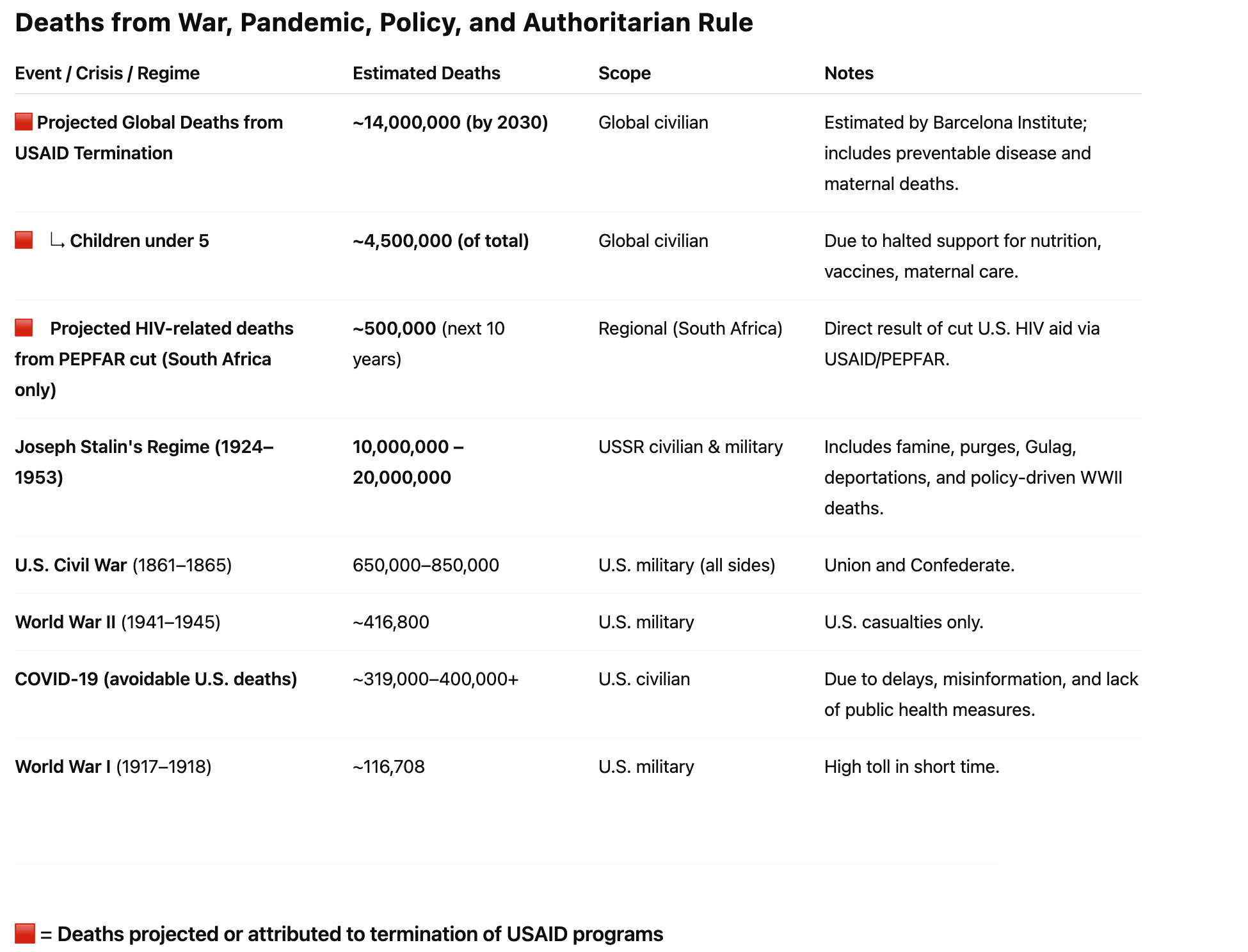
You can see that Stalin was truly an overachiever, though Trump has him clearly in his sights12.
No doubt ethics classes wrestle with the question of societal accountability all the time, as a case study to unpack and with nuances to explore. The US has undoubtedly saved millions of lives through programs like USAID over the years; perhaps if we truly couldn’t afford it any more, would that makes us less culpable? Long before Trump, many have argued that we should be investing more in our own citizens before helping those overseas. After all, a quarter of American children are at threat of under- and malnutrition. Surely we should be doing more for our own citizenry. But often I find these arguments somewhat naïve; even ignoring the moral imperatives, global society is simply too intertwined. A pandemic happening on the other side the planet inevitably spreads to the US. A violent and poor South American country results in an increase in legal and illegal immigration. Poverty breeds radicalism which breeds terrorism. Ignoring this, with moves like eliminating USAID, is too much cutting off one’s nose to spite one’s face13.
In any discussion of accountability, it seems necessary to discuss intent, and I haven’t touched on this issue yet. There are a couple of reasons for that, both practical and cynical. On one hand we often need to infer a person’s intentions for any specific act. Even when someone states their intention we need to bring a skeptical eye to their statements; people are notoriously disingenuous when describing why they perform any given action. On the other hand, as we’ve seen over the last 20 odd years, the lawyering of America has contributed to the erosion of the legal system and with it, the rule of law. It’s hard to understand how UC Berkeley can show its face in public after hiring John Yoo to educate students after he wordsmithed his way to saying waterboarding isn’t torture. The intent of the law be damned, creatures like John Yoo can impose new intent on existing law.
The other problem with the search for intent is that we end up looking for reasons, a rationale. I think this is part of what’s so frustrating about the actions of the Trump administration. We think, “what’s the reason he’s cutting funding for public health initiatives”, or “what’s the reason he’s destroying American leadership in science”. These are typically answered by the politically mendacious talking points. This form of rationalization is natural, but leads to a kind of sanewashing, particularly since it isolates specific actions, and diverts us from seeing the whole picture. Taken collectively, the destruction of our national cybersecurity protection, the removal of professional leadership at the Pentagon, the assaults on public health and education unmistakably point to the real goal here, the diminishment of America as a country to enable the enrichment and concentration of wealth and health of those in power. The stated rationale is little more than marketing.
We’ve come a long way from my initial question, what’s Trump’s body count. What we can probably start with are the unnecessary deaths due to him during the first few years of the pandemic. It’d be worth adding in the much smaller but persistent attacks against his political enemies and liberals, due to his endorsement of violence14. Factoring in the USAID deaths and growth in preventable diseases due to vaccine denial is necessary but needs careful analysis and handling. What I’d love to see is a professional media organization take up this question and begin tracking it in real-time. Perhaps this could take the form of an above-the-fold item, a boxed number that’s updated regularly.
To close this out I should really address what justice would look like for the millions who will die horrible and unnecessary deaths ultimately due to this one man15. For this, however, I find myself rendered mute as I struggle to remain on the justice side of the equation. I suspect justice in this case is multi-dimensional. Trump and his enablers need to be held accountable and punished to the full extent of the law, that much is clear. Further, we as a nation need to find someway to both heal and put into place mechanisms that prevent a rogue president (or any governmental agent) from having such a casual disregard for social and moral norms. I’m not convinced we have many terrific examples historically to learn from. Germany post WWII? The Nuremberg trials? The South African Truth and Reconciliation Commision? History is replete with catastrophes wrought by men of Trump’s ilk, yet we keep repeating them.
https://pubmed.ncbi.nlm.nih.gov/9521945/. I suspect most people don’t associate religious freedom with ‘freedom to murder children’, but here we are. Religious institutions remain the last unimpeachable carve out from civil rights. Thanks Hobby Lobby. Or should I thank the SCOTUS? Perhaps the people that voted for the president that appointed the SCOTUS? It’s turtles all the way down.
Or as I like to say, “why chose?”. Of course this example is highly nuanced and a mature analysis would look at multiple dimensions including partisan gerrymandering and misinformation.
https://www.pbs.org/newshour/nation/obama-team-left-pandemic-playbook-for-trump-administration-officials-confirm. https://www.politico.com/news/2020/03/17/how-trump-shifted-his-tone-on-coronavirus-134246. https://www.americanprogress.org/article/5-ways-trump-administrations-policy-failures-compounded-coronavirus-induced-economic-crisis/.
https://1000wordphilosophy.com/2021/07/14/hobbes-on-the-state-of-nature/. No, I’m not advocating for Hobbes.
It occurs to me as I copy edit, that it might be better to call the Civil War, The War to End Slavery (TWES). Since the winners get to name things.
My personal awareness of this stems from growing up in Colorado where I became keenly aware that the Rocky Flats nuclear trigger factory, home of lost and burnt plutonium, was located near the Coors brewery. https://cumulis.epa.gov/supercpad/SiteProfiles/index.cfm?fuseaction=second.Cleanup&id=0800360#bkground.
Well, we thought The War to Defend Slavery ended, but as the Federal government collapses, watch for “state’s rights” to inflect back towards first the disenfranchisement of African-Americans as citizens, and second, the reestablishment of slavery as a form of legal punishment. The south will rise again.
There are many entries I’ve overlooked. Mao is certainly a contender. GW Bush is responsible for ~100k Iraqi civilian deaths, and as is now well documented the invasion of Iraq had nothing to do with 9/11. Thousands of injured or crippled Americans survived the war and of course it’s hard not to lay the increase in veteran suicides at Bush’s feet: https://watson.brown.edu/costsofwar/papers/2021/Suicides. Then again, despite the disrespect that Trump shows veterans, people still voted for him, suggesting America’s appreciation for veterans may be more cosplay patriotism than sincere.
Like so many have pointed out, while the GOP insists programs like food stamps, medicaid, and other forms of welfare are supporting lazy Americans, we continue to subsidize the wealthy at truly mind boggling levels. https://subsidytracker.goodjobsfirst.org/subsidy-tracker/nv-tesla-motors. Fundamentally I believe we can take care of ourselves and be good global citizens.
I know many people will argue, perhaps rightfully, that it’s too simple to assign full blame to Trump for terrible situations around the globe. It’s true, that if someone is being mugged, the assailant is a guilty party. But in a moral universe, if we are not merely beasts of our worst nature, so is the individual who fails to stop and help.
A compelling post, and I like how you weave together a whole bunch of stuff in a stream of consciousness sort of way. It does read as a kind of venting of rage and frustration at the lack of “justice” in the moral arc of which we spoke over lunch the other day, albeit a completely legitimate and relatable venting for those of us singing in the same choir. Not just the lack of accountability for Trump and his co-fascists, but by extension how history is littered with morally despicable people who can get away with figurative and literal murder seemingly indefinitely, or at least long before the feeble “history will judge them harshly” time frame takes effect (if ever). It resonated with me because, as you know, we share a disgust at sh*tty entities doing sh*tty things, seemingly without any sort of consequences.
With a tighter/clearer through line to connect the dots and an expanded bibliography, this could easily be an article for a larger audience (or perhaps even a book!). While the piece is centered on Trump’s culpability, you make the natural connection to a broader responsibility for the "body count" associated with the callous GOP/MAGA movement that he represents. It’s a reasonable assertion that Trump is both a symptom and an accelerant of a broader political pathology, and using him as a springboard to analyze the true scope of the damage done by his ilk could occupy all of your time for years to come. Talk about a worthy retirement project! 🙂
Incidentally, while you only very lightly tie this to the usual topic of your blog via “the destruction of our national cybersecurity protection”, the overarching harm done by a Trump/MAGA/Project 2025 “strategy” driven almost exclusively by grievance, retribution, and hate is hard to miss. It weighs heavily not just on cybersecurity, but a host of other ways in which individuals and society at large are ultimately made far less secure. See, you already have a topic for a sequel to the first book. 😉